Showing posts with label Hollow Earth Expedition. Show all posts

Thursday, February 17, 2011

Hollow Earth Update

Have I been lazy about updating or what?

The new found interest in 40k has been a bit of a nerd-time suck. I've got my second game this weekend and I've been modeling like mad. Fortunately, the guys I'm playing with are okay with me showing up with unpainted models, so I've actually had time to eat, sleep, go to work, etc.

My tuesday night my regular group (Dave, Allen, Hickey, Paul and Brad) finished up our Hollow Earth Expedition adventure. Brad was absent and Paul, being back from tour, got his first chance at play in the Hollow Earth.

The adventurers had succeeded in thwarting Dr. Von Wartenberg's plan to steal the Atlantean crystal in the previous adventure, but discovered their way out of the Hollow Earth had abandoned them. They decided to follow the Nazi's tracks through the jungle. They heard some tribal drumming and what sounded like a woman shouting insults. The heroes quickly (and quietly moved towards the sounds) and stumbled across what appeared to be humanoid lizards in the midst of a ritual sacrifice of a beautiful woman (played by Paul -- hah). Some chaos and combat ensued and woman is released and joins the fight against her reptilian captors. When the group realizes that more lizardmen are being alerted to the disturbance, the party high-tails it towards a raft on the river bed.

They proceed down the river, with much chaos (including a fight on the raft with 2 lizardmen and a velociraptor and almost going over a giant waterfall), and eventually find a ruined temple in the valley beneath the waterfall. Inside the temple, they are able to solve a puzzle that opens the waterfall. There are a bunch of traps which are navigated on the way to a large room with some sort of glowing crystal. The players grab the crystal, shit goes haywire, the caverns start to flood. The snooty professors falls in the drink, and Dr Dan the field biologist gets crushed in a trap.

They stumble out of the ruins and notice the prof crawling out of the lake looking like a drowned rat, but otherwise okay. As the waterfall begins to close, they realize they are surrounded by Nazis, let by Von Wartenberg. As he delivers a soliloquy on what happens to those who defy the Reich, the adventurers spot a pack of lizardmen making their way towards the group. From the other direction a horde of Raptors and finally, from the surface of the lake, a giant octopus surfaces. As the 5 way fight breaks out, the players high-tail it into the jungle as the screen fades to black.

Good game. I think everyone enjoyed it and we'll likely run more HEX adventures in the future. Definitely recommended for folks looking for some pulpy action and adventure.

Thursday, January 27, 2011

Status Update

Wow! It looks like I let over a week creep by with out a post. I not doing a good job of keeping up with my self-appointed posting numbers. I should be doing some studying for some up coming games, really, but I'll sneak a post in before that, and hopefully get some feedback.

Speaking of upcoming games, I'll be running my second session of Swords & Wizardry White Box this weekend. All seven players from the first session were so enamored with the play style (particularly the speed and lethality of the combat), that they demanded a deeper delve into the dungeon. When we last left them, they were down a man or two after a scuffle with some goblins in a hallway. Fortunately, they left some potential adventurers up with the horses and supplies on the surface level. Those unnamed mooks will be getting tossed into the scrum.

Tuesday, I'll be running another session of Hollow Earth Expedition for my regular crew. As I mentioned in a recent post, it went over big, so we're going to keep rolling with it for a few more sessions. I decided to drop some cash over at FRP Games to pick up the GM Screen, Secrets of the Surface World and Mysteries of Hollow Earth source books. Eventually, I foresee a longer, campaign style game, with the players actually generating characters instead of using the pre-gens from the book. Well, at least I hope that happens, since I put another $70 into the system.

Expect some brief play reports from the sessions in the next few days. After HEX wraps up, we have to decide what is next. Allen, who runs my regular Call of Cthulhu game has offered to do CoC adventure for this group, which could be a good experience for everyone. After that, it may be time to revisit the ongoing 4e campaign for a few sessions.

Up next will be a post on "Appendix N" and my exposure thus far.

Wednesday, January 19, 2011

More thoughts on HEX

I had a question about the Hollow Earth Expedition System after my previous post. I was typing a response in the comments and realized I was going a bit long, so instead I decided to expand it into a more complete post. If anyone has any additional questions, let me know and I'll try to answer, based on my experiences playing / game mastering.

Ubiquity Dice
Hollow Earth Expedition uses a dice pool system, known as Ubiquity Roleplaying System. With Ubiquity, you can roll any dice you own, as long as they have an even number of sides (so keep those Gamescience d3s, d5s, and d7s in your dice bag). Instead of looking for 4 or better, like your might in a table-top war game like Warhammer, you're just looking for the even numbers. Count them up and that gives you the number of "successes". Alternatively, Exile Games sells a set of "Ubiquity Dice" to use with the game. It's kind of an innovative system to cut down on the number of you roll each turn. I picked up a set at Origins last year after checking out a game demo. Essentially, the white die is the equivalent of rolling "one die", the red die is the equivalent of rolling "two dice", and the blue die is the equivalent of rolling "three dice". All the probabilities are worked out with the numbers on the faces. So, to represent a dice pool of 6, you can either roll 6 white dice, 3 red dice, 2 blue dice, or 1 white, 1 red, and 1 blue, or 2 red and 1 blue, and so forth. I was the only one using the Ubiquity Dice last night. As a bit of a dice nerd, it was fun to use something off the wall, but by no means necessary. Then again, our Big Game Hunter was dumping 14 dice on the table every time he fired his rifle. He could have done that with 3 blues, 2 reds and a white from my pool (the Ubiquity Dice set comes with 3 of each color).

The GM determines how challenging the task should be, allowing for adjustment for creative ideas or tactical advantages. The system also supports the use of the average successes for scenarios where time is not a factor and nothing critical is happening. For example, in last night's game one of the players has a high Linguistics skill. We decided that he understands the basics of most European languages to avoid having to roll every time one of the NPCs spoke Norwegian. When that same NPC spoke Atlantean, he had to make a roll, because it was unlike any language he had experienced. Even with a success, he was only able to understand the very basics of what was said. It allowed the game to move quickly, but we could leave it to chance when that had the opportunity to make the game more interesting.


Combat is handled with opposed rolls. The attacker rolls a number of dice based on his or her weapon skill and the quality of the weapon. In the case of our Big Game Hunter, that number turned out to be 14. Here's how it breaks down: Firearms are based on your dexterity (4 for BGH). During character creation, he spends build points on three levels and buys a Talent, boosting his Firearms rating another 2. Additionally he buys a specialization in rifles, adding another point, bring him to a total of 10 dice. The .405 Winchester Rifle has a rating a 4L (the L stands for lethal damage). There it is 14 dice. When using his .455 Webley revolver with a 3L, his attack drops to 12 dice, because he can't count the rifle specialization. The defender rolls his defense rating. I don't have my books in front of me, but I think the defense rating is a combination of your Intelligence and Dexterity scores (plus any armor you might be wearing). Subtract the defense success from the attack successes to determine the damage you take. There are some rules for cover and special attacks, but those are the basics. It sounds a bit complicated, guess, but in practice it went pretty fast. People seemed to enjoy having the "active" defense, because I think everyone likes rolling dice. Their dice rolling prowess (aka LUCK) had something to do with how well they shrugged off a potential hit.


Hollow Earth Expedition
I've never played any other dice pool system, and I don't think any of my players have much, if any, experience with them either. The rules were light enough that everyone picked up on it pretty quickly. Since I was the only one who owns/read the book, we skipped over some of the fiddly options for combat (like the continuous initiative option and some more advanced combat actions).

Having a more limited/generalized skill set, than say, BRP or Call of Cthulhu, allowed the players to be a bit more free-form/creative with their actions, and the skills and skill specializations made sense to everyone. I think the players were pretty innovative in combining their player smarts and character skills.  The Style points were also popular. As I said in the previous post, the players did a pretty good job getting into character and seemed legitimately excited to gain a Style Point. I need to refresh myself on the rules and suggestions for distributing the points throughout the game. I'm not sure if they were going out too easily or I was being stingy, but it felt right for a first try at the system.


I found it a bit funny that my players were kind of in Call of Cthulhu mode, rather than high adventure mode, but that might have been related to their selection of characters.

"Hey Guys! We're going on a big adventure, filled with all kinds of crazy traps and dinosaurs and evil Nazis!!"
"I wanna be a snooty college professor!"
"I call the Field Biologist!!!"

My one concern, so far, with HEX is handling future adventures. Part of the fun of the game was the players not knowing what was going to happen. I pretty much told them that we'd be playing a pulp adventure game. I made some references to some books and movies for framework, and they new the game was Called Hollow Earth Expedition, but they didn't know much else about the setting. How do you keep the concept of a foreign world interesting to the players if they've delved into the world in the past. You loose the freak-out my players experience when their characters watches and compasses malfunctioned and the sun never set. You can roleplay that feeling for a new set of characters, but not for the players behind those characters.

I think the Ubiquity system could easily be used for other gaming styles, but there doesn't seem to be much else out there right now. There's no reason that I noticed that you couldn't reskin the skills, talents, and flaws, for fantasy, sci-fi, horror, etc. I see that an upcoming supplement for the game is called Revelations of Mars, which I have to assume will allow for some Sci-Fi gaming. There is also a fairly active section of the Exile Games Forum, where folks discuss alternate uses for the Ubiquity system. I could see this eventually competing alongside Savage Worlds as a nice, compact, generic system for running a variety of games. The folks at Exile would probably need to do some significant work to strip off the pulp adventure layer, though.

The world is big enough, and with the two supplementary products currently in print (Secrets of the Surface World and Mysteries of Hollow Earth) there is more than enough for players to do and see. I'm curious to see how this demo game develops and if my players request a longer campaign in the future. After finally getting to play a game, I do plan on grabbing those books, plus the GM screen at some point. Unfortunately, it doesn't look like any of my FLGS currently carry this game. I'm going to talk to Jeff down at Phantom of the Attic to see if they can get it from their distributors, though, as I'd rather pass the cash through them than Amazon or something.

Entering the Hollow Earth

My regular Tuesday night group had their first adventure in the Hollow Earth last night. I made some slight modifications to the adventure featured in the back of the Hollow Earth Expedition core rule book...

The Cast of Characters -
Allen - Dr. Whipple Van Phillips - Snooty Professor
Brad - Crosby ?? - Big Game Hunter
Dave - Dr. Daniel ?? - Field Biologist
Hickey - Dr. Albert Franklin - Mad Scientist

I laid out a few sample pre-generated characters that were available on the Exile Games website (the same that are included in the book). The players veered towards the more scholarly types, with the lone exception of the rifle-toting Big Game Hunter. Other options were Fortune Hunter, Rugged Explorer, Occult Investigator, and Intrepid Reporter. 

I won't bore you with a full recap of the adventure, as it is mostly retelling of the sample adventure, with a few minor additions. Since two of the four players have a fair amount of experience playing Call of Cthulhu, they had a basic understanding of what it means to play and investigative game and jumped right in, looking for clues and leaving no stone unturned. The other two players caught on quickly. I feel like I gave up some information a bit too easily,  but they were really drilling me with questions and observations, so any game master is bound to slip up occasionally.

I will say that my players did come up with some fairly interesting methods for resolving the problems and did a great job playing in character. I wasn't sure how many Style Points I should have distributed throughout the evening, but Allen, particularly, was cracking me up with his snooty behavior. He insulted everyone at the table at least twice, prodded a velociraptor with his umbrella, and scooted up a tree at the first sign of trouble (including making sure to climb just a bit higher than his compatriot in the same tree, assuming the raptor might be full after the meal of Field Biologist). Everyone had their moments to shine, though. Dave befriending a triceratops and arguing the scientific method, Hickey blowing up a dino with a makeshift bomb and attempting to sell mining equipment to Norwegians. Brad regularly threatening folks with his boom stick and putting his neck on the line to protect the others.

Overall impressions? First, all the players seemed to be enjoying the session. They were coming up with creative solutions to the problems. The one bit of combat went pretty quickly (though I missed an opportunity to introduce some NPCs in the manner I planned, because I was so wrapped up in all of it.) It was fast and fun, but I think I'm going to need some work. I might have another player joining, and where I left it, it might be a challenge to introduce him. Additionally, the story as written in the book is about to wrap. I have some ideas on where to go next, but it's going to depend on the direction the players take it. I've dropped plenty of hooks for future adventures, but I have no inkling which direction they'll go with it, which is good. I need more practice at not "over-planning" and railroading, for sure. I'd like to run at least two or three more sessions of the game, to get a  good feel for it before moving on to something else.

Up next? Returning to re-read some of the fluff sections of the HEX book and see where we might take this. I'm going to need to so some sort of planning to at least have a basic story arc to work from. I think the game can be used for sandbox storytelling, but the way I've started the adventure, it's looking like it would be best to have some sort of resolution at the end. Since this is a distinct short adventure, I really feel the need to have a beginning, middle and end to a story-line, even if it gets pretty free-fore there in the middle. I'll also need to review some of the mechanics. I'm thinking that some of the parts I'm confused about may make a bit more sense, now that we've successfully completed a game session.

If we end up playing again in the future (and I hope we do), I'd certainly like to allow the players to create their own characters. I skipped it this time, because we're all still learning the rules and I didn't want to blow the whole first session on character development. It was nice, because the sample characters came complete with notes regarding

Wednesday, January 5, 2011

Recording, travel, and the Hollow Earth

It's really too late for me to be writing this post. I should be sleeping by since, since I'm due into the office in about 8 hours. My reason for being awake at 1:00 AM on a "school night"? My band, Abysme, was in the studio for our third day of tracking for our debut LP, Strange Rites. My bass parts were all done, but I wanted to be there with the guitarist while he did his overdubs, so I could verify all my parts were okay. We still need to do the vocals and mixing. No set day for release yet, either, but it is getting closer, hopefully by the Summer of 2011? Hopefully...

Thursday, I'll be heading to San Diego for the American Library Association Midwinter Meeting. If any of my readers know of any awesome gaming stores or used book stores in the downtown area, please let me know. I'll be there until Tuesday and I'll have some down time. Right now, I'm mostly in the market for old stuff, but if I found a store with a good selection of Savage Worlds or Hollow Earth Expedition books, I'd likely pick up a few things. If the store is only likely to carry newer stuff (d20, Pathfinder, 4e), I'm probably not that interested, right now.

To make sure there is at least something gaming related on here, I've been studying the rules section of the Hollow Earth Expedition rule book for an adventure that will start on January 18th, hopefully. Everything "makes sense", but I'm a little nervous, as I haven't actually played the game, outside of a 10 minute demo at Origins this past Summer. I usually like to get some time as a player before I sit down and try to run something, but I don't know anyone who runs HEX. We'll see how it goes. The players are all friends, and are all pretty forgiving of foibles, so it should be fine. It will be a new experience for a few of them, though, because they are more familiar with more "tactics-heavy" rules, like D&D 3 & 4. I'm hoping they can all get into the "mind" of the pre-generated characters I'm providing, because if they spend too much time worrying about what's on the character sheet, this might be a flop. The group isn't that heavily geared towards the actual role-playing aspects of the games we play, it seems. They do great with the exploration, puzzle solving, and combat, though. Role playing is definitely one of my limitations as a Game Master, too. I really need to get more practice at portraying the NPCs in a realistic manner. They aren't (all) just cannon fodder or hint/rumor delivery units. I'm hoping this game experience will bring all of us out of their shells, at least a little bit.

I'm going to use a published adventure for the seed. Since the game is so different from what I'm used to running, I'm having a hard time gauging how long it will take the players to complete the adventure. One thing that is great about the adventure is that it leaves a lot of threads open. When the players complete the primary task, there are still plenty of options. I'm trying not to over-plan, so I don't end up railroading them. I think the system is light enough that I can come up with something on the fly, if we need more content. I hope to keep it running for at least three or four sessions, assuming everyone is having fun and I can come up with enough threads to keep them busy.

Finally, I'm working on scheduling the next session for the Swords & Wizardry White Box game. All seven players seem pretty excited about it, so hopefully we'll be able to continue the game for a while. One nice thing about dealing with that many folks: if someone misses a session or drops out of the game, we still have more than enough people at the table to play. Dealing with that many personalities (and schedules) can be a real challenge, but I think it will work out in the end.

Saturday, January 1, 2011

Projections and Reflections

Seems like the blog-0-sphere is rife with posts giving the "2010 in Review" and "What's on the Plate for 2011" type posts. I figure it's as good a time as any for reflection and prediction. The slate is clean, in a sense. I was hoping to get a few more posts made before the end of 2010, but averaging over a post a week isn't so bad, all in all. I got a little distracted by the holidays, shopping, a new Wii and episodes of Angel on Netflix. Granted the blog was buried from March until October. If it weren't for successfully completing the Daily Blog Challenge in November, I wouldn't be anywhere near that number.

I started this blog about a year ago...I made few posts and it stalled. I recognized the problem almost immediately. There was no direction. I wanted to leave it as open as possible, allowing me to write about all sorts of topics of interest. The problem? It didn't really keep my interest. You see, I don't think of myself as a natural writer or anything. I don't dislike the writing process, but the words don't just "flow" for me, either. Combine that with a long standing desire to procrastinate and0 any lack of focus is probably a bad thing. If you go back to those earliest posts you'll see a bunch of brief movie reviews, some commentary on Food Network programming, a couple posts on RPGs.

Back in October, I decided to resurrect the blog and give it a bit of focus. Gaming, and RPGs specifically have been taking up a lot of my free time these days (although I still do watch a fair amount of trashy movies, listen to heavy metal records, and watch Food Network programming -- though I do wish we had access to their newish Cooking Channel with our current cable service. The programming over there appears to me much more my "style"...I can't believe I just admitted to that...anyway)...

So what is in store for 2011? More gaming, for sure, and hopefully more posting. Right now, I'm considering setting a schedule for myself. I'd love to average 12-16 posts a month, which is quite a high number, considering my posting history. For that to happen, I'm going to need some inspiration, so in the coming days, expect to see some posts that are more brainstorming than content or review. We'll see what happens. I'm going to apply for the Role Playing Game Bloggers Network at the end of January, because I'm hoping that having potentially more readers will be an enticement to post more content.

Well, what about 2010? It was a big gaming year for me, for sure. I've met a bunch of cool new people, I went to a couple gaming cons, I've found some great blogs, I've bought some box sets, and I've played a bunch of games.

October was my first visit to GASP Games day, and honestly, I'm kicking myself for not checking out this group sooner. Great people. Great games. I highly recommend it to anyone in the Pittsburgh area interested in trying out new games. At that first event, I didn't know anyone there. I started making some contacts on the forum, but just showed up ready to play. I got to check out a bunch of board games and I was finally able to check out Labyrinth Lord. I also went to my first "big" gaming convention, Origins, where I got to play Aces & Eights and Hackmaster Basic, sat through some RPG demos, checked out a bunch of board and card games. 2010 was my inaugural attendance at GASPCon, too. Again, I wish I had checked the event earlier. I met even more rad people and played way too many hours of RPGs. Right now, I'm planning on signing up to GM at least on session at the next con.

That Labyrinth Lord game at GASP Games day really set me off on a huge OSR / OD&D / retro-clone kick. I had been following some of the games for a few months, but hadn't played that style of D&D since the late 80s. Since then, I've played 4 additional sessions of LL, a session of Spellcraft & Swordplay, a session of Lamentations of the Flame Princess, and a session of Hackmaster Basic. I refereed a session of Swords & Wizardry which appears to have the potential to turn into a campaign. In addition to all that, my "every other Tuesday" group is still going strong. We started out as a 4e group, but due to a little 4e burnout on my part we've been exploring other games. We just wrapped a 3 session Gamma World (new edition) adventure. In a couple weeks, I'll be running a Hollow Earth Expedition adventure. We're not sure where were going after that; maybe back to the 4e campaign for a while, maybe some Savage Worlds, maybe something else. More details as they become available. The 3.5 Ravenloft Campaign I play in sputtered for a while, but seems to be back in the swing. The same could be said for the 3.5 Forgotten Realms campaign. The Call of Cthulhu game is still going strong, although I believe we're approaching the end of the story arc.

Since deciding to focus this blog on gaming, I haven't posted much on other topics. I quit my regular DJing gig down at the Smiling Moose. We were doing a weekly "Metal Night". All vinyl. Old school. Anyway, the crowds morphed into packs, and the packs morphed into stragglers. I was burned out of playing records for the same 15 dudes every week, so we called it off. No regrets, but my heart really wasn't in it any more. My heavy metal record collecting has definitely slowed this year, too. I already own more records than I know what to do with, but the lure of vinyl is strong. I have all the old records I want that are easy to find. I got lucky and started collecting Heavy Metal records before the collector mentality took over the scene, so I was able to grab a lot of the cool 80s stuff before it got out of hand expensive. There are still some gaps I'd love to fill in, but I have no love for eBay (or paying $50 for 30 year old record). Because of eBay, and n00bs willing to drop that kind of cash, I'm kind of out of luck. The cool records just aren't showing up in the shops like they used to...they're all in collectors hands or sitting on eBay at ridiculous prices. Oh well, like I said, I already have more than I know what to do with.

My band, Abysme, is set to begin recording our debut LP, Strange Rites, tomorrow. It's death metal, taking influences from Entombed, Nihilist, Hellhammer, Celtic Frost and Repulsion. If that sounds like it's up your alley, check us out. We'll be playing the Smiling Moose on January 15 with Nunslaughter and Derketa.

Well, that's enough for now.

Tuesday, November 30, 2010

HEX character generation

Here it is...the eve of the last day of Daily Blog Challenge. Today, I'm going to walk through the process of creating a character using the rules in Hollow Earth Expedition. It's going to be sort of a live blogging experience. Keep in mind, I've only played about a 10 minute demo of the game. I've never seen in played otherwise. I've read most of the rule book, though.

Step 1: Archetype
Since this is my first attempt at character generation, I'm going to go with one of the archetypes in the book. I'm going to go with Soldier, since there isn't an example in the book. The adventure I'm planning on running for my players will likely have some government connection to kick it off, so offering a soldier as a pre-gen makes sense. Apologies ahead of time to any military folks in the audience. My military experience doesn't extend much past watching "The Dirty Dozen" a couple times.

Step 2: Motivation
Again, there is the option to select between the motivations in the book and making up your own. I'm going with a motivation Duty. Kind of cliched for the Soldier, I suppose, but I'm just feeling things out right now.

Step 3: Attributes
Starting characters have 15 points to spend on starting attributes. You have to spread them between 6 attributes. Nothing can be over 5 or under 1 (so essentially 6 of your points are accounted for off the bat). I decided this guy was some sort of sniper, so I gave him a 4 in Dexterity and a 3s in Strength and Intelligence. He's got 2s in Body and Willpower, so he's a bit of a glass-jaw for now, but that's okay. That left me with 1 left for charisma. He's not so good in social situations. Maybe he's a bit "backwoods" or something?

Step 4: Secondary Attributes
Secondary attributes are based directly what you selected for Step 3. You just fill in the blanks. I ended up with a Move and Initiative of 7, Defense of 6, and Perception of 5. I think that works for the character concept.

Step 5: Skills
Here's where you determine what your character is good at. Since I was going with the military sniper motif, I gave his some ranks in firearms with a rifle specialization. He also has Brawl and Melee (with a spear specialization, which applies to the bayonet on the rifle). I also gave him Larceny, with a specialization in Security and Stealth with Camouflage specialization (for entering and hiding in those good sniping spots).

Step 6: Talents and Resources
You start with one talent or resource. I chose to the resource Rank.

Step 7: Flaws
I chose Superstitious. I decided the character has a lucky lighter that he rubs and fiddles with all the time. If he loses the lighter, he's psychs himself out and is less effective.

Step 8: Experience
You start with an additional 15 points to spend, but the skills and attributes aren't as cheap now. Since he's supposed to be a sniper, I spent all 15 to get the Accuracy talent, which allows him to ignore -2 worth of penalty on a called shot.

Step 9: Finishing touches
I equipped the guy with a .30-06, a bayonet, and a Colt M1911 pistol, general adventuring gear including a backpack, binoculars, fatigues, rope, a scope, and a few other things. It's more than $100 listed in the book, but I'm using my Rank resource to justify it. I still need to write a bit of background for the character, but it's coming together nicely.

Step 10: Style
He's going to get a style-point for the flaw. I'll give him a couple more once I write that background.

That's it. Mechanically, I was able to throw this together in about an hour, with no previous experience. That said, I had a pretty well defined, and simple, character in mind when I started. I'm sort of tossing around the idea of letting the players come up with the characters, rather than just jamming pre-gens in their faces, but it could be a bit too time consuming, considering I'm the only one with the book.

Saturday, November 27, 2010

The rest of Hollow Earth Expedition

I've been putting this off all day, but here it is...Yes! It is Daily Blog Challenge post 27...

No inspiration yet today. I'm feeling rather spent. I guess it was a long night with one too many beers or something. I watched the Pens win then City of Lost Children. I'm still considering another show this evening, but I don't have much motivation to leave the house this evening. I kind of want to crash out right now...

Since I haven't come up with anything better to write about, and I'm too tired to try to come up with something more interesting, I'll go through the last few chapters of Hollow Earth Expedition. I'm hoping this series of posts will prove helpful for me when I putting the game together. Sometimes writing about something makes it all a bit more clear.

Chapter 6 is on Gamemastering. Rather than assuming the reader has no knowledge of RPGs, the book actually assumes that this isn't your first experience running a role-playing game. Rather than spending a lot of pages talking about the generalities of RPG gamemastering, it jumps in with content specific to HEX. As someone who has read a fair number of gamemastering chapters for different games, it was a nice change of pace. "You already know how to do this. Here's some tips for doing it with HEX." There are sections on genre conventions, HEX conventions, and story structure. The chapter also provides a great deal of good information for forming both short and long campaigns. There are some great story seeds and some examples of developing the seeds into a plan for a game. I think these few pages have given me enough to put something together for my players.

Related to yesterday's post, where I talked about whether or not to use a battle mat for combat, the chapter does actually specifically state that HEX is not a tactical game and is not designed to be played with miniatures. I'm glad to see it in print, as I wasn't planning on running the game in that fashion anyway. There are some great examples given for getting the players and GM on the same page. For example, there is a suggestion for inviting the players over for a pre-campaign party, where you watch one of the films suggested in the appendix for inspiration, then discuss ideas for the up-coming campaign. With this information, the players can make some informed decisions as to what type of character to create. I won't do this for our demo game, but it sounds like a great technique for getting everyone on the same thematic page.

Chapter 7 is a sort of gazetteer for Hollow Earth, offering possible entry ways and a cosmology, explaining "how things work". I know a lot of my players read the blog, so I don't want to give away any spoilers at this point. Chapter 8 is titled "Friends and Enemies". It includes a laundry list of possible friendly and not-so-friendly organizations and NPCs. The NPCs are fully statted-out, and generic enough that they could be applied to any campaign a GM would want to run. There is a section for surface world people and groups and another for Hollow Earth people and groups. Chapter 9 is the bestiary, which features all sorts of dinos, giant animals, and deadly plants! Finally, there is a sample adventure, a pretty good list of pulp resources which includes print, film, comic book, radio, and television, a glossary, and an index.

I'm getting very excited about trying out the game. As I believe I mentioned (probably a few times), I'll be running HEX for my regular game group as soon as our Gamma World adventure wraps. I'll be sure to update with a game report and comments once that happens.

Friday, November 26, 2010

Combat (and more) in the Hollow Earth

Submitted for your approval, Daily Blog Challenge post 26.

As promised, I'm here to talk a little bit about the combat rules in Hollow Earth Expedition. I'm plowing through the rule book to prep for running a demo game for friends. Talking about the game the other day piqued some interest around the table, so I volunteered to try to sort out the rules and give it a go...

The Combat chapter starts with an overview of the combat turn, which should look pretty typical for most gamers. Roll initiative, take some actions, make an attack and defense, calculate damage, rinse, repeat if necessary. Initiative is handled by the players rolling a number of dice equal to their initiative number. The player with the most successes (even numbers on the dice) goes first, then the player with the next highest, etc, until everyone goes, then the next turn starts. There is an optional set of rules for "Continuous Combat" which mimics the initiative rules in Hackmaster Basic and Aces & Eights, where different types of actions take different lengths of time. It helps equalize fast, but light damage weapons, like daggers with slower, big damage weapons, like great swords. Fast weapon fighters might get off an extra attack or two before the slow weapon fighter gets to swing again. It's an interesting concept, but there is no way I'm going to try to include it in my demo game. Too much to track for new players and a new GM.

In combat, players are able to move, attack, and defend each round. There are a wide variety of options for attacking including aiming, calling shots, charging and disarming. It all makes logical sense, but it's a bit more complicated than I would have assumed, based on the 10 minute demo I played at Origins and the flavor of the earlier text in the book. "Complicated" might be the wrong word here? Maybe "crunchy" is the better term. Granted, compared to something like Hackmaster Basic or 4th edition D&D, this looks like a breeze. Certainly not an exercise in tactical miniature war-gaming crammed into an RPG, but it makes me wonder if it will slow down the action at all. I guess I was expecting this section to be a bit more "rules-light", in line with the Rules and Intro chapters. My players don't have the rule book, so explaining all the combat options will be tedious. Hopefully, they will come up with creative ideas that mimic the options in the book, and I can referee as appropriate. I realize I can modify what is here for a more cinematic feel, stripping a lot of the special abilities and actions in combat.

I don't know of there is an intent to use a battle mat in combat, but I don't think so...It's never reference in the combat section (at least that I noticed), but there are a lot of references to distance, both in range of weapons and effects of certain attacks and damage. Maybe I'm just so used to playing with a mat in the newer editions of D&D, that I have a harder time thinking about these things in an abstract sense. I didn't plan on using any minis to play the game, but maybe we'll end up using some if we run into a more detailed combat scenario. I'm certainly not opposed to using them, but I sometimes feel like players get to attached to the minis and it strips the cinematic qualities out of the scenario. It turns into a lot of counting and jockeying for position, rather that high action and adventure.

The damage, wounds and healing sections move back to keeping things fast and loose. Instead of requiring extra dice to determine damage, the character suffers the difference between the attacker's success count and his/her defense success count. If you go below zero, you are dying. If you go below -5, you are dead. Wounds heal slowly (non-lethal = 1 per day, lethal = 1 per week), but medical attention and first aid can speed it up. The chapter also has sections on environmental hazards, diseases, poisons, and other threats to character health (falling, electrocution, fatigue, exposure, and fire, for example).

Following the combat chapter, there is a chapter on equipment, with weapons, armor, exploration gear, vehicles and "weird science". Since damage is handled by taking the difference between the attack and defense rolls, the weapons don't have standard variable weapon damage. More deadly weapons have a higher damage bonus. The damage bonus increases the number of dice added to the attack roll. A scimitar has a damage bonus of 3, where a pen knife has a damage bonus of zero. The "weird science" section only includes some sample artifacts, with the expectation that creative players (and game masters intent on offering up villains of the mad-scientist flavor) come up with their own ideas. The sky seems to be the limit here, allowing the GM to referee the process as necessary.

I'll give an overview of the rest of the sections of the book in a few days. I gotta throw together some food before heading over to Gooki's for the Brown Angel record release show. Heavy...

If you want a basic overview of HEX, without dropping any cash, check out the Exile Game Studio website. They have downloads for the 2008 & 2009 Free RPG Day adventures. Obviously, they've simplified the rules greatly for these demos, but they hint at the basic flavor of the game.

More details when I actually get to play the game and see how I handle it from the GM perspective. If anyone has any experience playing or running HEX, let me know in the comments. Any hints or suggestions would be greatly appreciated.

Thursday, November 25, 2010

Getting ready for the expedition

Ooh...another late post, but here it is: Daily Blog Challenge post 24. Yes. Technically it is the 25th, but I'm sticking with my plan of at least posting before I sleep for the day, so we're good to go...Fortunately, all I need to do on the 25th is wake-up and drive the 2 hours to Oil City then eat. Not much else going on tomorrow.

As for my excuse for the late post? I don't have a good one today. I did some laundry, watched some Mythbusters and the Pens game, played the demo of Puzzle Quest 2, and did some reading. A fair amount of reading, actually.

Hollow Earth ExpeditionIn preparation for my turn back behind the screen once the Gamma World adventure wraps up, I started ripping through Hollow Earth Expedition. I picked up the book at origins this summer after a quick demo at the booth, but I never really sat down and read it. I have to say, the writing is darn good.

First off, if you are a fan of pulpy adventure stories and that cover doesn't draw you in, you best check your pulse. It is well matched to Hollow Earth Expedition's style: threatened explorers, big-ass dinosaurs, crazy looking scientific equipment. The back cover features some remnants of a ruin civilization. The book itself starts with an introductory pulp adventure story to set the tone followed by an overview of HEX and roleplaying. Pretty standard info here. We're then presented with a sort of gazetteer for Earth, ca. 1936. As the depression continues, the Nazis, Fascists, and Communists are coming to power around the world. There are sections for each region of the world and an overview of fashion, entertainment, and travel in the time period. For someone who doesn't really think about World History all that much, it was quite helpful. In college, when most folks were taking History 101, or whatever, I was studying the history of science. Oh well...

Chapter 2 covers character creation and is loaded with examples for developing the character you want to play. The examples provide a pretty clear thought process for how to develop a character to match your imagination. They also provided 12 complete characters, along with role playing notes and character background. These characters are perfect for inspiring players who need a little push or can be used a pre-gens if you like.

Chapter 3 gets into the rules and explains the Ubiquity system used to run the game. Ubiquity uses a dice pool system, where you have a certain number of nice in each of your attributes in skills. The player is trying to get a certain number of "successes", as determined by the GM. Instead of have a cut off number, such as getting "4 or better" on a six sided die, the players are trying to roll "evens". Every even number counts as a success; each odd is a failure. Sounds pretty intuitive to me. The game also has a system known as "Style Points". Style Points are a bit like Bennies in Savage Worlds. You can use them to get extra dice before you roll, soak damage in combat, or power up your talents. Players get style points in game for roleplaying or benefiting the game. Instant reward system. Nice. Again, there are great examples throughout the chapter to help players understand how to gain and use the style points.

In typical pulp style, I'm going to leave you with a cliff hanger for now. I'll cover chapters 4-9 in a couple days, after I have a bit more time to digest the info. Skimming through, they cover combat, give an example of play (I really love reading examples of play a little too much, I think), equipment, game mastering, Hollow Earth gazetteer, friends and enemies, bestiary, and a sample adventure.

Monday, November 15, 2010

Coming soon to a table near me...

It feels great to finally be caught up with post number 15 for the Daily Blog Challenge.

As I mentioned a few times in the past few weeks, my regular gaming group is taking a break from our 4e campaign. For a few of the players, this campaign was their first extended experience playing D&D of any flavor. It is also my first experience at running a campaign of this length. In the two years since the campaign started, I think we've learned a lot about our strengths and weaknesses as RPG Gamers. There are a few things that, given the opportunity, I'd go back in time and change. Right now, I feel like I've made the campaign my story, rather than the groups story. Roleplaying is pretty limited, with many of the characters being more of a set of stats on a sheet of paper with an odd quirk or two, rather than having any real personality. I think it's the nature of the world we've created. I was kind of terrified of losing control of the game. 4e is so dense with rules that it is hard (for me at least) to do anything on the fly. I've railroaded and the players went along with it. It can be easier for both sides, that is for sure.

I'm really curious how the players will react to a game which requires more roleplaying and features less tactical combat. Since I'm going to have at least a month of downtime, while Dave acts as GM for the Gamma World, I'm going to try to put together a few things together. I like the idea of putting together a few adventures using different play styles and systems. A lot of the old school systems and clones, and some of the newer pulpy systems like Savage Worlds and Hollow Earth Expedition, are rules-lite enough that the players should be able to pick up on how to play, and get a pretty good feeling for the style of play after just a session or two. Additionally, I'd like to open the table up to an extra player or two. I know a few people that are interested in checking out a game. The ongoing campaign probably isn't the best place to try to indoctrinate these guys into the hobby, but a convention style demo game over a night or two could be perfect.

Cover
Once Dave's Gamma World adventure wraps up, I'm planning on throwing together a pulpy monster hunter game using the Savage World rules and the Rippers setting. In Rippers, the players take on the role of Victorian era monster hunters, utilizing body parts from slain monsters to augment their characters, known as Rippertech. Essentially, they end up sort of like a crew of Van Helsings or the League of Extraordinary Gentlemen or something.

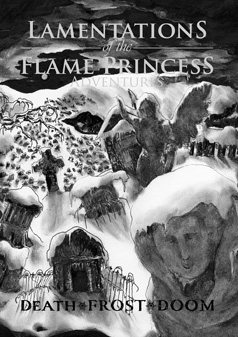
Following the Rippers game, I think I'm going to try running one of James Raggi's adventures, most likely Death Frost Doom, using the Lamentations of the Flame Princess rules set. I know that most of the players are pretty big fans of the film that inspired the adventure, which will remain nameless as to hold up the surprise for the players. I hope they get a kick out of the combination of old school D&D mixed with a creepy investigative horror.

Hollow Earth ExpeditionFinally, I'm going to try running something using Hollow Earth Expedition. I think at least a couple of the players will enjoy the two-fisted pulp tales of adventure offered by the setting. The game mechanic, using the Ubiquity system, is pretty interesting. Ubiquity, which attempts to offer very cinematic game play, uses dice pools to determine successes and failures. It also stresses that the focus should be on cinematic action story telling over excessive dice rolling and has built in rewards for players who (at least attempt) to pull off exciting feats of daring. The mini demo I played at Origins this summer was a blast and I think we can have a lot of fun with it.

Depending on how those three games progress, we'll make some decisions about what is next. I want to try out Realms of Cthulhu, Low Life, and other Savage Worlds settings. Plus there are all the other OSR options like Labyrinth Lord, Mutant Future, and Swords & Wizardry. I'm hoping to do a bit of development of a setting for each of these games, allowing us to return and play more adventures linked to the trial game, essentially setting up a sort of sandbox we can return to if we choose. I'm planning on using pre-gens, because I find that creating characters before you really understand how a game is played can be a real challenge. If we do return to any of these worlds, at that point the players would be able to create their own characters or continue to play and develop the pregen. I'd also like to turn over the reigns to other players in the group to take a shot at GMing something if they are interested.

If anyone reading has any experience running any of the games mentioned and has suggestions for making good one-shots or know of good online resources for the games, let me know. Additionally, if you have any suggestions for introducing players used to playing tactical RPGs like D&D 3.5 and 4e to less tactical games which feature role playing.